
Open-plan offices are brilliant for collaboration. They’re also, very often, loud. Phone calls carry across the floor, conversations bounce off glass and hard walls, and the person trying to finish a report ends up wearing headphones just to think.
The good news is that a noisy office is rarely a lost cause. With the right mix of acoustic panels, acoustic pods and a few smart layout changes, you can keep the energy of an open-plan space without the constant distraction. At M2 Office, we help businesses across Ireland find that balance every day. Here’s how to do it.
What is the best way to reduce noise in an open-plan office?
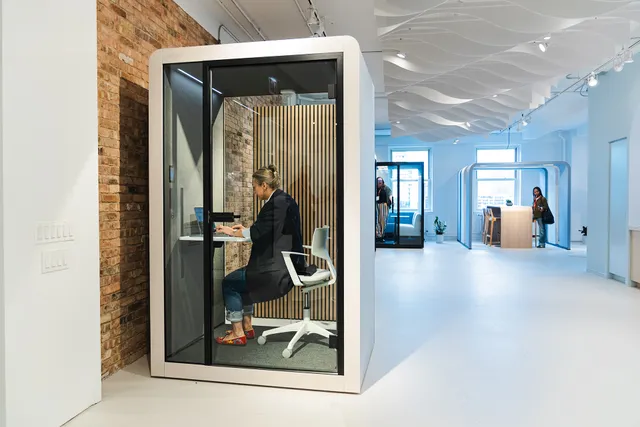
The best way to reduce noise in an open-plan office is to combine sound absorption with quiet, enclosed spaces. Acoustic panels absorb echo across the room, while acoustic pods give people somewhere private for calls and focused work. The most effective solutions are:
- Acoustic wall panels
- Acoustic ceiling panels and baffles
- Acoustic pods and phone booths
- Free-standing acoustic screens
- Acoustic feature walls and slatted wood panels
- Soft flooring such as carpet tiles
- Acoustic planters and soft furnishings
- Zoning your layout into loud and quiet areas
Why are open-plan offices so noisy?
Most office noise problems come down to two things: hard surfaces and nowhere to go. Glass, plasterboard, concrete ceilings and hard floors reflect sound rather than absorbing it, so a single conversation can echo across the whole space. At the same time, without enclosed spaces, every call and every meeting happens in the middle of everyone else’s work.
That’s why the best results come from tackling both problems at once: soaking up the echo, and giving people a quiet place to step into.
Acoustic panels vs acoustic pods – Which do you need?
This is one of the most common questions we hear, and the honest answer is that most offices benefit from both. They do different jobs.
| Acoustic panels | Acoustic pods | |
|---|---|---|
| What they do | Absorb sound and reduce echo across the room | Contain sound inside an enclosed space |
| Best for | Reducing background noise across the whole office | Private calls, video meetings and focused work |
| Installation | Mounted on walls or ceilings | Free-standing, no building work needed |
| Privacy | Improves comfort, but conversations can still be heard | Gives people a private space to talk |
In short, acoustic panels make the whole office calmer, and acoustic pods give individuals somewhere to escape. Used together, they solve both halves of the noise problem.
8 acoustic solutions that work for Open Space Office
1. Acoustic wall panels
Acoustic wall panels are often the first and most effective step. They absorb sound that would otherwise bounce off hard walls, which reduces echo and makes conversations far less distracting. They don’t have to look technical either: panels come in a range of shapes, fabrics and colours, and printed designs can double as artwork or a branded feature.
2. Acoustic ceiling panels and baffles
In offices with high or exposed ceilings, a lot of noise bounces down from above. Acoustic ceiling panels and hanging baffles absorb that sound before it spreads, and they’re a good option when wall space is limited or taken up by windows and screens.
3. Acoustic pods and phone booths
When people need to make a call, join a video meeting or simply concentrate, an acoustic pod gives them a quiet space without the need to build new rooms. A single-person acoustic phone booth works well for calls, while small, medium and large meeting pods suit everything from one-to-ones to team meetings. Our Koala Acoustic Pods guide explains the different types and sizes, and you can design your own with our pod configurator.
4. Free-standing acoustic screens
Free-standing acoustic screens are one of the most flexible ways to cut noise between desks. Desktop and floor-standing screens absorb sound at head height, where conversations actually happen, and they can be moved as your team or layout changes.
5. Acoustic feature walls and slatted wood panels
If you want acoustics that make a design statement, acoustic feature walls and slatted wood wall panels combine sound absorption with a warm, modern finish. They work particularly well in reception areas, boardrooms and breakout spaces, where first impressions matter as much as acoustics.
6. Soft flooring
Hard floors amplify footsteps, chair movement and general background noise. Switching to carpet tiles or adding rugs in busy areas absorbs that sound at ground level and makes a noticeable difference to how the whole office feels. Browse our full range of office flooring to compare options.
7. Acoustic planters and soft furnishings
Soft surfaces of all kinds help absorb sound. Acoustic planters combine greenery with sound absorption, and upholstered collaborative seating and sofas soften breakout areas that would otherwise echo.
8. Zone your layout into loud and quiet areas
Sometimes the simplest fix is moving things around. Keep collaborative areas, kitchens and printers away from desks used for focused work, and use glass partitions or screens to separate the two. Our office design and layout team can help you plan a space where noise naturally stays where it belongs. If you’re still weighing up your options, our guide to open-plan vs private offices is a useful read.
A quieter office doesn’t mean losing the buzz that makes open-plan working so effective. It means giving your team the right balance of shared and private space. Explore our full range of acoustic solutions and acoustic pods, or get in touch with M2 Office to book an acoustic assessment.
Frequently asked questions
Do acoustic panels really work?
Yes. Acoustic panels absorb sound waves instead of reflecting them, which reduces echo and background noise across a room. They work best when placed on several surfaces, such as walls and ceilings, rather than in a single spot.
Are acoustic pods soundproof?
Acoustic pods are designed to contain sound and greatly reduce noise passing in and out, giving people a private space for calls and focused work. They are not fully soundproof rooms, but they offer a high level of speech privacy in an open-plan office.
How many acoustic panels do I need for my office?
It depends on the size of the room, its ceiling height and how many hard surfaces it has. The most reliable way to find out is an acoustic assessment, which works out the right type and number of panels for your space.
What is the difference between soundproofing and acoustic treatment?
Soundproofing stops sound travelling from one space to another, while acoustic treatment, such as acoustic panels, improves how sound behaves within a room by reducing echo. Most open-plan offices need acoustic treatment, with acoustic pods adding private spaces where needed.